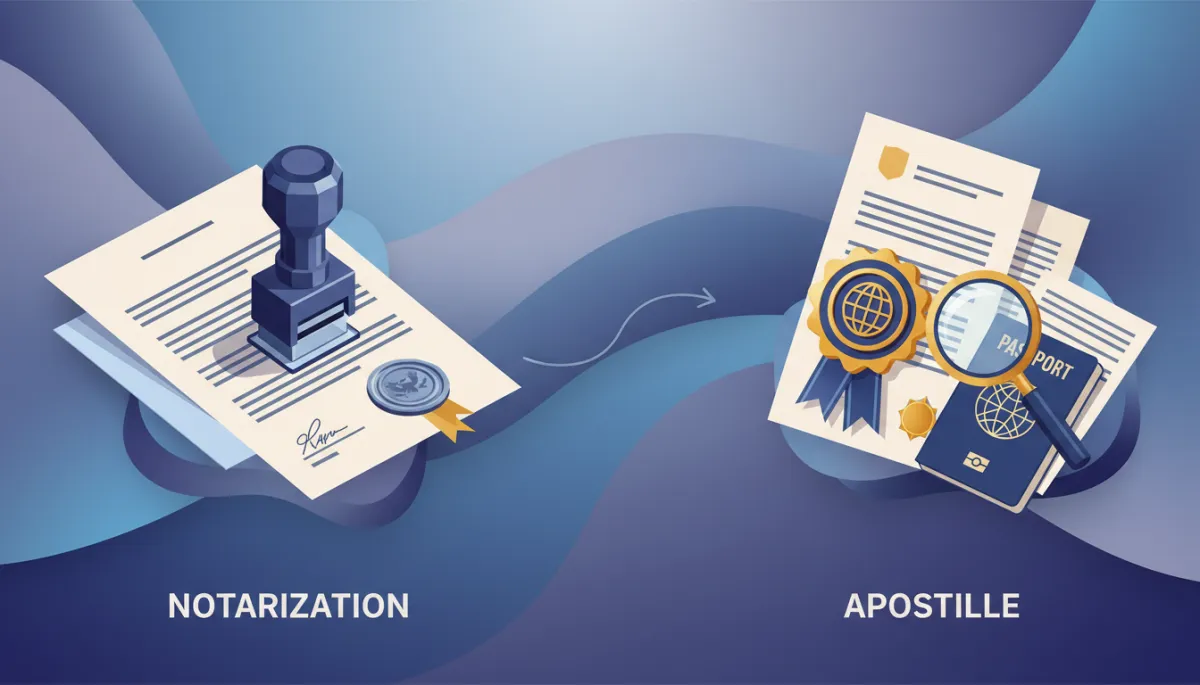
Notarization vs Apostille: Key Differences Explained
Legal Services, Notarization, Apostille, International Documents
Notarization vs Apostille: What Consumers Need to Know Before Sending Documents Abroad
If you have ever been asked for “notarized documents” or an “apostille” for a visa, job, or overseas transaction, you know how confusing the terminology can be. This guide breaks down, in clear language, the difference between notarization and apostille, and explains exactly when and why an apostille is needed so you can avoid costly delays and rejected paperwork.
What Is Notarization?
Notarization is a domestic process. It is carried out by a commissioned notary public in your state or country. The notary’s role is not to approve the content of your document, but to verify the identity of the person signing it and to witness that signature. In other words, notarization helps prevent fraud by confirming that:
The signer is who they claim to be (through valid ID)
The signer is signing willingly and understands what they are signing
The document is signed in the notary’s presence, or acknowledged before the notary
After checking ID and witnessing the signature, the notary attaches a notarial certificate, signs, and applies an official stamp or seal. This creates a record that the notarization took place on a specific date, in a specific jurisdiction. Within your own country, many institutions—banks, courts, title companies, and government agencies—rely on notarization as a basic safeguard against forgery and identity theft.
📌 Key Takeaway: Notarization confirms who signed a document and that they did so properly, but it does not make the document valid worldwide.
What Is an Apostille?
An apostille is a special type of international certificate that verifies the authenticity of a public document so it will be accepted in another country. It was created under the Hague Apostille Convention, an international treaty designed to simplify the way documents are recognized across borders.
Where notarization is performed by a notary, an apostille is issued by a designated government authority—often the Secretary of State, Ministry of Foreign Affairs, or a similar office. The apostille does not approve the content of your document either. Instead, it confirms that:
The signature on the document is genuine
The person who signed (for example, a notary, registrar, or court clerk) had the authority to do so
Any official seal or stamp on the document is authentic
The apostille is usually attached as a separate certificate, often with a distinctive layout and a reference number. Once attached, your document can be presented in another member country of the Hague Convention and treated as legally authenticated without further legalization steps.

An apostille certifies the authenticity of signatures so foreign authorities can trust your documents.
Notarization vs Apostille: Understanding the Core Difference
At first glance, both notarization and apostille seem to be about “stamping” a document. The real distinction lies in their purpose and scope:
Who they are for: Notarization is primarily for use within your own country. An apostille is specifically for use outside your country, in another Hague Convention member state.
Who issues them: Notarization is performed by a notary public; an apostille is issued by a government authority that verifies the notary or official’s signature and seal.
What they confirm: Notarization focuses on the act of signing. Apostille focuses on the authenticity of the signature and capacity of the official who signed.
You can think of notarization as a first layer of trust at the local level, and the apostille as a second layer of trust that makes that local verification recognizable abroad. In many cases, you need both: the document is notarized first, then the apostille is issued on the notary’s signature or on the public document itself.
💡 Pro Tip: If your document will stay within your country, notarization is usually enough. If it is going overseas, check whether the destination country requires an apostille.
When Do You Need an Apostille?
You typically need an apostille when a document issued in one country will be used for an official purpose in another country that is part of the Hague Apostille Convention. Common situations for individuals and consumers include:
Immigration and visas: Birth certificates, marriage certificates, police clearance letters, and affidavits requested by a foreign immigration authority often require an apostille.
Studying abroad: Diplomas, transcripts, and letters of enrollment may need apostilles before foreign universities or licensing boards will accept them.
Working overseas: Employment contracts, professional licenses, and background checks used for overseas job placements are frequently apostilled.
Marriage or divorce abroad: If you are marrying in another country or registering a divorce decree overseas, civil status documents often require apostilles.
Property and inheritance: Powers of attorney, wills, and probate documents used to manage property or estates in another country may need apostilles so foreign registries will recognize them.
Always check the exact requirements from the foreign authority—consulate, embassy, university, court, or employer—because they will specify whether they require an apostille, a simple notarization, or additional steps such as translation by a certified translator.
Why Is an Apostille Needed at All?
From the perspective of the foreign country, your local notary or registrar is an unknown official. They do not have direct access to your government’s databases, and they cannot easily verify whether a stamp or signature from another country is real. The apostille solves this problem by acting as a trusted bridge between legal systems.
An apostille is needed because it:
Builds trust quickly: Authorities abroad can rely on the apostille as proof that your document has been issued or notarized by a legitimate official in your country.
Prevents fraud: By confirming the authenticity of signatures and seals, apostilles make it much harder to submit forged documents in international processes.
Simplifies international procedures: Before the Hague Convention, documents often needed multiple stamps from consulates and ministries. The apostille replaces that long chain with a single, standardized certificate.
In practice, this means your application is processed faster and with fewer questions. Without an apostille where one is required, your documents can be rejected outright, forcing you to start over, resubmit paperwork, and potentially miss important deadlines for visas, enrollment, or transactions.
Do All Countries Use Apostilles?
No. The apostille system only applies between countries that are members of the Hague Apostille Convention. If your document is destined for a non-member country, you may need a different process called consular legalization, which often involves both your own government and the foreign embassy or consulate. The underlying idea is similar—verifying authenticity—but the steps and offices involved differ.
This is another reason it is important to confirm requirements early. What looks like a simple notarization request can, in an international context, become a multi-step process involving notarization, apostille, and certified translation. Planning ahead saves time, money, and stress.
How to Decide What Your Document Needs
When you receive instructions that mention notarization or apostille, use these questions as a quick checklist:
Where will the document be used? If it stays within your country, notarization is usually sufficient. If it goes abroad, ask whether the destination country is a Hague Convention member and whether they require an apostille.
What type of document is it? Vital records (birth, marriage, death), court orders, educational records, and notarized affidavits are frequently apostilled for international use.
Who is asking for it? Follow the written instructions from the foreign authority closely. If they specify “apostille,” a simple notarization will not be enough.
If anything is unclear, it is better to ask questions in advance than to guess. Clarifying whether you need notarization, an apostille, or both can prevent delays that ripple through travel plans, job offers, or legal proceedings.
Final Thoughts: Choosing the Right Level of Certification
Notarization and apostille serve different but complementary purposes. Notarization protects against fraud at home by verifying who signed your document. An apostille extends that trust across borders, giving foreign authorities confidence that your documents are genuine and properly issued. Understanding this difference helps you make informed decisions, budget correctly, and meet your deadlines—whether you are studying abroad, relocating for work, managing family affairs, or handling cross-border property and inheritance.
Before you send any important document overseas, pause and ask: Is notarization enough, or do I also need an apostille? Taking that small step now can save you weeks of waiting and the frustration of having documents rejected on the other side of the world.